
By Rachel Walker, ’27
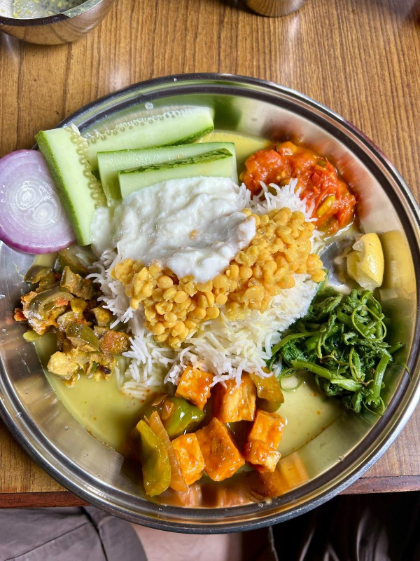
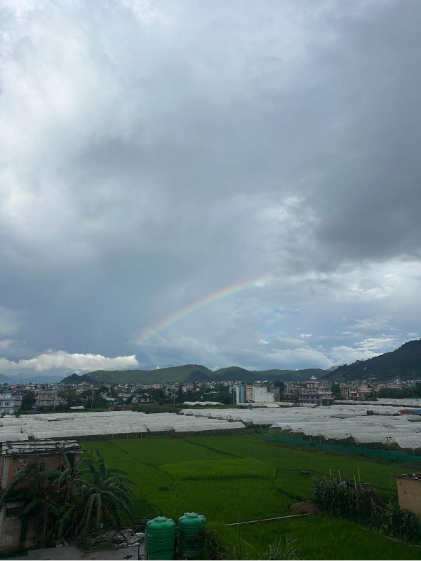
When I arrived in Nepal, I had never seen a rice paddy before. I came to learn that the green I saw painted all around my host family’s home was rice, for as long as I could see. In Nepali, there are three words for rice. Dhaan is unhusked rice growing in the paddies. Chaamal is unhusked, dried, uncooked rice, and bhaat is steamed rice, ready to eat. This gave me pause. To have three separate ways of referring to something that I view as all the same thing signals a deep significance, an engagement with this cycle to which multiple terms are affixed.
I did not think too much about the dhaan as something living and growing until after returning from our first two-week-long study trip. In my absence, something changed. I could tell how much the dhaan had grown because it reached a new place on my legs when I walked by. The color was slightly more yellow. The stalks were a bit harder. It was swimming in less water. And so, I began to pay attention to it.
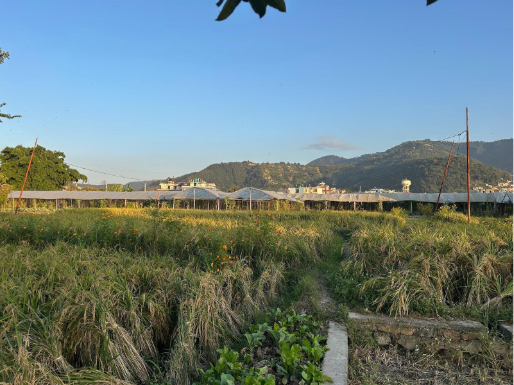
Right before leaving for fall break, the dhaan hit a growth spurt. It was suddenly too tall to support its own weight, slumping over into the ground, which was now more mud than water. My host mom demonstrated to me the next week’s work – gathering large bundles of dhaan together and tightly wrapping a few stalks around them so that they would stand up straight for their last few weeks before being cut. It then occurred to me that I would be here to see that harvest, that I had been in Nepal long enough to watch the dhaan move on from being dhaan.
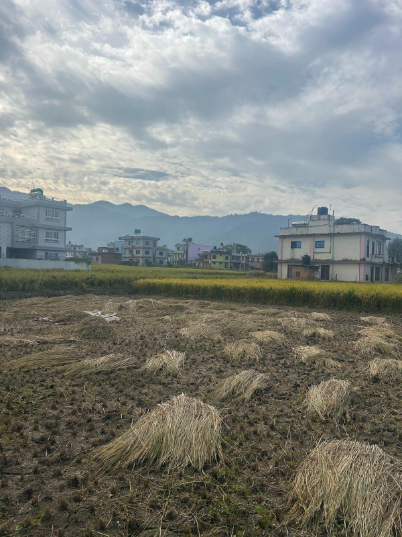
When I returned from fall break, the dhaan – which was small and light green and just reached my knees when I arrived in Nepal – had grown and hardened and was golden and hip height. The water at its base had completely dried up, and it stood tall and strong, lightly tilting with the breeze. It was time for the dhaan to be cut. The stalks were carefully sliced at the base, then spun on a paddy thresher until the stalks were bare, and the chaamal was processed and bagged.
The chaamal, too, required more labor and attention. We dried it out on the roof, each morning raking it out across the concrete and each evening piling it up under a tarp. I was repeatedly stunned by the sheer amount of time and labor that the food required and how much attention it was given. When rainy clouds threatened, the whole family ran up to the roof at 6:30 am to bag up the rice and bring it downstairs as quickly as possible. When food has had so much work put into it, when it will provide energy and sustenance for so much time to come, it deserves this care and love.
In the field, we turned over the now half-dry stalks so that the sun could suck the moisture out of the remaining green. Two days later, the stalks were bundled up into piles and carried over to the cow house. All morning, I threw the bundles up one floor to the upper area of the cow house, where my host mom and I neatly piled them into the loft to become straw for the cows to eat and to put them on their floor. As I got into the rhythm of throwing the bundles of stalks, my body a machine, lifting and swinging, I got an idea that I’ve deeply felt across my time in Nepal – this notion of cycles being passed down generations. When I arrived in Nepal, I saw the organic material in the rice paddies when it was young, small, and light green. At this moment, I was processing this same organic material to become food for my family and for the cows. I get to watch this material go from its journey as a young plant to food to eventually decomposing back into the very earth it came from, its nutrients sustaining future crops. At home, I haven’t ever engaged with a food’s life cycle so intimately before, using every part of the crop and not letting anything go to waste. To me, it reflects an important Nepali value that I hope to take back to the U.S. with me: that everything has a use, however small, and in using things in their entirety, that value can be realized.
If I were only here for a week, if I were here as a tourist, perhaps the cycle of dhaan to chaamal to bhaat would not phase me. I might let it pass me by like any other season. But this cycle is incredibly significant because I am living and eating and harvesting and growing here and here, dhaan means sustenance means life. So how could I not notice? How could I not notice the life that lies before me, wrapped in a green husk turned golden and cut and dried and processed until it fills my stomach with energy and life.
When I arrived in Nepal, the dhaan was not ready for harvest. It had to be nourished with sun and water. It had to be given time to grow and stretch. I was the same. In August, the parts that now feel easiest about being here felt the hardest. The parts that feel hard now would have been unimaginable then. I could not fathom talking about complex, real issues in Nepali. I could not imagine making my own Nepali friends, cracking jokes in a language I have only been learning for a few months. I’m now conducting independent research on birth and death customs, living alone in a new village, but back then, I could not have come to a completely new place with questions and ideas and a desire to talk to people and learn – all in Nepali. I, too, had to be nourished, with the help of my teachers and my host family, with delicious food and kindness from people I had only just met. I had to be given time to grow and stretch, to make mistakes and take risks and figure things out. We only harvested the dhaan when it was ready. It became chamaal because time had passed, because it had grown and was ready for the next stage. I, too, have gone through stages. I have grown and transformed. There is no limit to my learning. I learn in the classroom, and when I am buying fruit, and when I am harvesting rice, and perhaps even as I wash the dishes. Even so, there is more to see and hear and taste and feel. There always will be. I want to sow the seeds for the dhaan, to watch another cycle. But my current cycle is nearing its completion. The dhaan became chamaal became bhaa,t and it’s time to go home. It’s now my job to gather up my memories like the stalks of rice bundled together, to bring them home with me and to use that learning for my own continued growth and good, sustained by the earth and by the work of strong and able hands.