

By Leila Bensrhir ’28
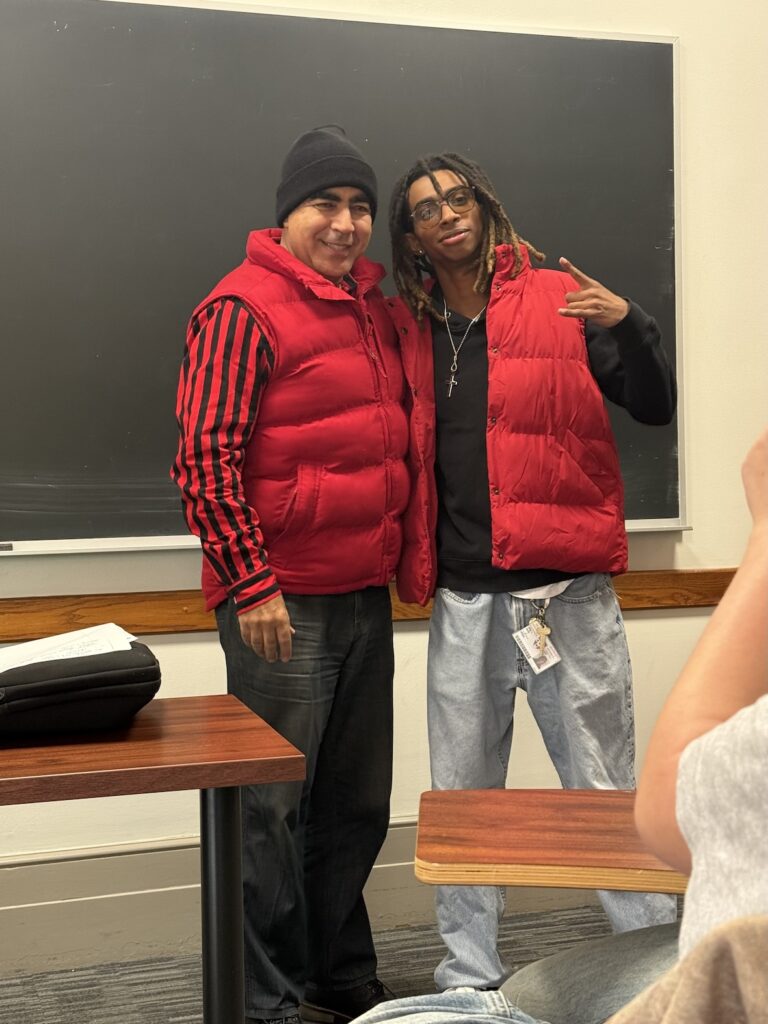
Some professors teach you a subject, and others remind you why learning can be such a beautiful experience in the first place. Professor Abderrahman Aissa, my Arabic professor at Wesleyan University, is one of those rare people who makes learning feel less like a classroom requirement and more like an opportunity to connect with the world around you.
One of the things I appreciate most about his teaching is how he makes language learning natural, engaging, and genuinely fun. Rather than limiting our conversations to textbook exercises and memorized phrases, he gives us the freedom to talk about what we actually want to talk about each day. We discuss things happening in our lives, our interests, and whatever else comes to mind. In doing so, he reminds us that language is not just something we study for an exam. It is something we use to express ourselves, understand others, and participate in everyday life. Learning Arabic becomes much more meaningful when we can connect it to our own experiences, and Professor Aissa makes that connection feel effortless.
Beyond his teaching methods, what makes him so special is his kindness. He is incredibly compassionate and understanding, and he creates an environment where students feel comfortable making mistakes, asking questions, and simply being themselves. Learning a new language can be intimidating, especially when you are afraid of saying something incorrectly, but his patience makes the process so much less stressful. He understands that every student has their own pace, background, and challenges, and he approaches each of us with genuine care.
He also makes an extraordinary effort to connect with his students as individuals. He takes an interest in our cultures, languages, and backgrounds, often sharing what he knows about them in ways that make you feel seen and appreciated. It is a small thing that makes a tremendous difference. You walk into class knowing that you are not just another student sitting in a chair. You are someone whose experiences and identity are worth knowing about.
And then there are the random facts.
It is almost impossible to leave one of his classes without learning something you never expected to learn that day. One moment, we might be practicing Arabic, and the next, he is sharing an interesting fact about history, art, literature, or another language. His knowledge seems endless, and his enthusiasm for sharing it makes even the most unexpected tangents fascinating. His classes are a reminder that learning does not have to be confined to a syllabus. There is always something new to discover if you have a teacher who is curious enough to share it.
His linguistic abilities are especially impressive. Beyond teaching Arabic, he also teaches Tamazight and Islamic History in Spanish, which is an incredible reflection of his knowledge and passion for languages and cultures. Seeing someone move between languages and subjects with such ease makes you appreciate just how much a love of learning can open up. He embodies the idea that language is a bridge between people, histories, and ways of understanding the world.
And, of course, I cannot write about Professor Aissa without mentioning the treats.
He often brings little treats to class, which is already such a thoughtful gesture. But the real danger is telling him that you like something. If you happen to mention that you enjoy a particular snack or treat, there is a very good chance he will show up less than a week later with it as a gift. Tell him you like his hat or scarf, and he’ll offer it to you or to purchase one. He remembers these little details and follows through in the sweetest way. It is such a simple example of the person he is. He pays attention, he remembers, and he finds ways to make people happy without expecting anything in return.
These small gestures say so much about him. His kindness is not something he saves for special occasions or formal interactions. It shows up in everyday conversations, in the way he teaches, in the things he remembers, and in the effort he makes to ensure his students feel comfortable and valued. He makes people feel cared for in ways that might seem small to an outsider but mean a great deal to the students who experience them.
College can sometimes make learning feel transactional. We take classes to fulfill requirements, earn grades, and prepare for whatever comes next. But professors like Abderrahman Aissa remind us that education is also about the people we meet, the perspectives we gain, and the relationships that make our time at university meaningful. He has a way of making a classroom feel welcoming, not because he has to, but because he genuinely cares about the people in it.
I hope Professor Aissa knows how appreciated he is. Teachers do not always get to see the full impact they have on their students, especially when that impact comes from a hundred small moments rather than one grand gesture. Maybe it is a conversation that makes a difficult day better, a random historical fact that sparks a new interest, a patient response when someone struggles with a sentence, or a favorite treat that appears simply because he remembered you liked it.
All these moments add up to something much bigger than a language class. They create an experience that students carry with them long after the semester ends.
Wesleyan would not be the same without Professor Aissa. I feel incredibly lucky to have the opportunity to learn from him, and I know that the students who pass through his classroom are lucky to experience the warmth, curiosity, and generosity he brings to everything he does.
Some people make you love a subject. Others make you love learning itself. Professor Aissa manages to do both, and I hope he knows just how much that means.