

By Natalie Kim ’28
“Why memorize words you’re never going to use?”
Learning a language can be really frustrating. In the U.S., English is by far the most commonly spoken language, and only around one in five people can speak anything else. Without people around you every day to practice speaking with, it’s hard to stay motivated to continue learning.
Conversely, I think the biggest benefit of the study abroad experience is the language immersion and being able to relate what you’re learning to your everyday life. Continue reading to see what I mean!
Intensive Mandarin Program
My study abroad program, CET, offers two options for language learning in Taiwan: the flexible track (focusing on English-taught classes about Taiwanese culture, politics, etc) and the intensive track (focusing on Chinese language learning). My top priority for studying abroad was improving my Chinese, so I picked the intensive track, which is run through National Taiwan University’s Chinese Language Division (CLD).
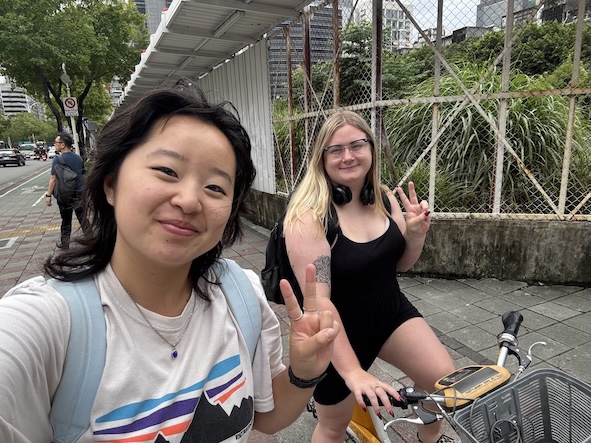
Every morning, I wake up bright and early at 7:30, bike to the CLD building, and attend a 3-hour Chinese class. CLD prioritizes small class sizes to ensure that everyone has lots of opportunities to practice, which I love – my class has five students total. I’m also really lucky to have an amazing teacher!
On top of in-class time, we also have around 3 hours of Chinese homework each day, and more on weekends. I’m also taking one elective class, so I have readings and assignments for that as well. And of course, I’m trying to explore Taipei too, so sometimes I go explore the city and eat dinner before I have a chance to sit down and start studying. I often find myself doing homework late into the night. It helps that my Taiwanese roommate 诚潔 (Chéngjié/Jessie) is also a night owl, so we usually commiserate over our homework after everyone else in the house is asleep.
All that is to say that the intensive track is not easy! The focus on language learning has definitely been an adjustment from what I’m used to at Wes, where I have lots of other demanding classes and club commitments that often get prioritized over Chinese.
My Textbook in Real Life
However, even with the late nights and early mornings, all the studying has been so incredibly rewarding because of how many natural opportunities I have to practice what I’m learning in class. In the U.S., the only time I’m speaking Chinese is for the few minutes I’m in class and maybe once a week with a language partner. But in Taiwan, I use Chinese so many times a day to text and chat with my Taiwanese friends, order food, and navigate daily life.
The curriculum covered in my textbook and class is so applicable to my experiences here that it’s honestly kind of uncanny. I’ll learn a completely new vocab word or grammar structure from my textbook that I’ve never heard before, and within the next week, I’ll use it and/or hear it when out and about.
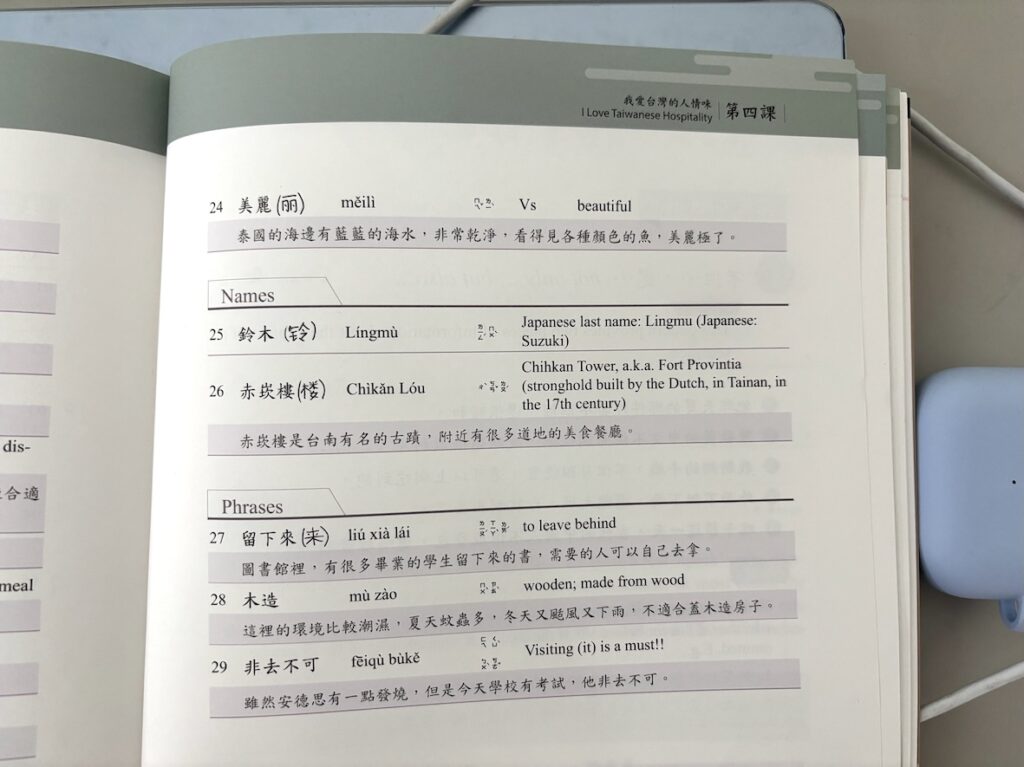
Sometimes it’s the most randomly specific things. For example, one of our lessons was on special places in Taiwan. We learned the word 赤崁楼 (Chìkǎn Lóu), which is the name of Chihkan Tower, a building in Tainan built by the Dutch in the 17th century, and the word 高铁 (gāotié), the name of Taiwan’s high-speed rail.
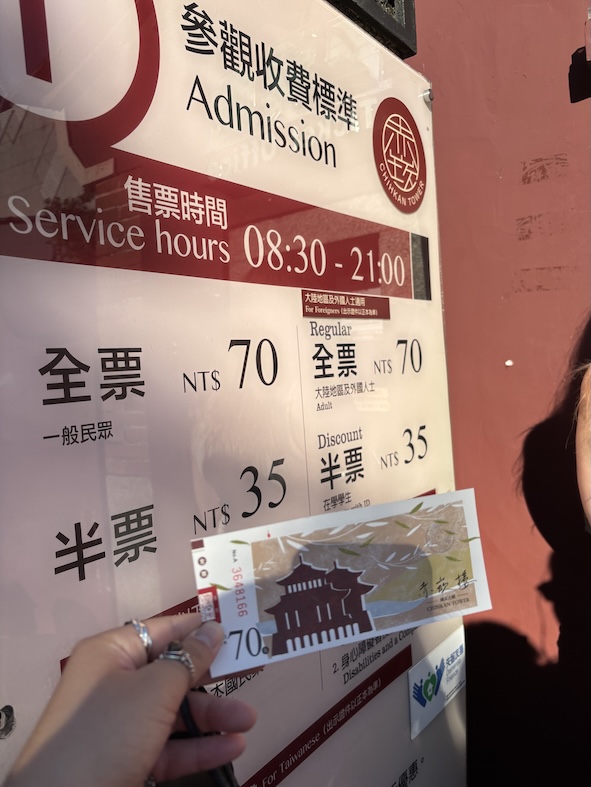
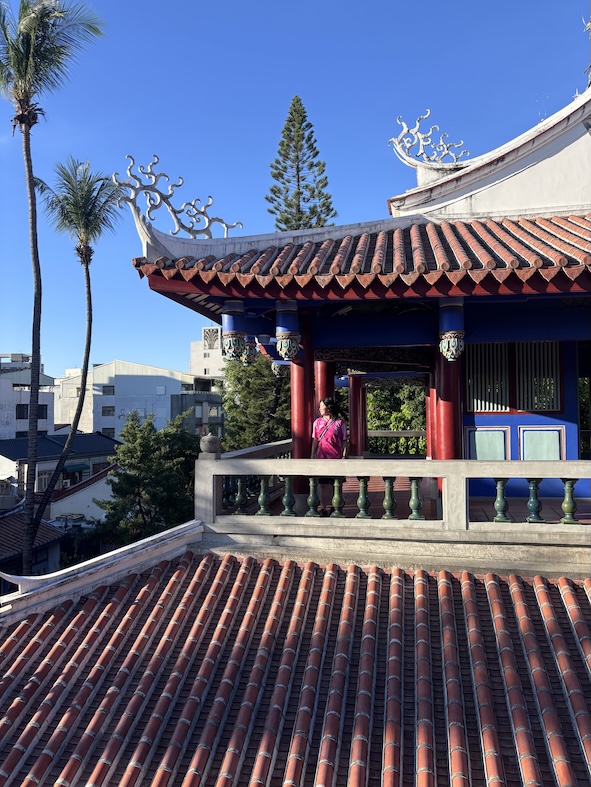
Part of our homework is memorizing how to write all of our vocab words (around 35-40 words per lesson, which is around 70-80 per week). I remember thinking I’d be tested on writing them and then immediately forget. But lo and behold, the next weekend, I found myself taking the high-speed rail to Tainan and visiting the Chihkan Tower!
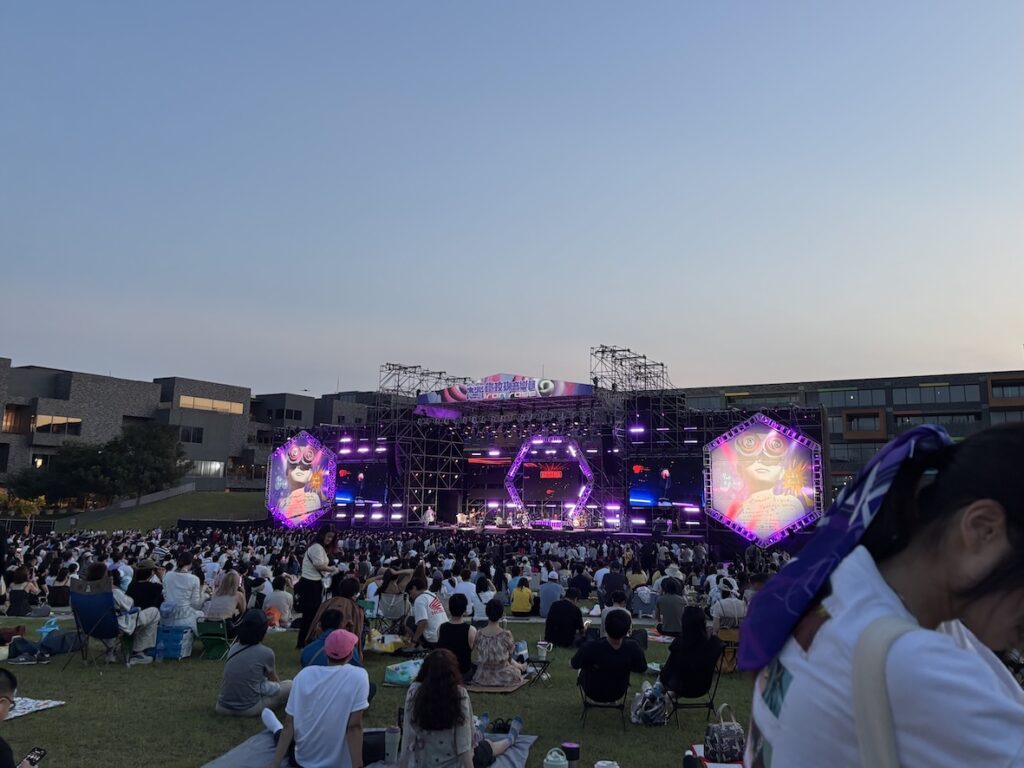
Another one of our lessons was on current trends and music. I spent a few days practicing how to write and say words like 樂團(yuètuán/band), 歌詞 (gēcí/lyrics), and 演唱會 (yǎnchànghuì/concert). Then that weekend, I went with Jessie to see one of her favorite bands 冰球(bīngqiú/Icyball) perform at a music festival. I went back to class on Monday and was able to use Chinese to talk about my experience in detail – not just that it was vaguely fun, but the names of the bands, the song lyrics, and the environment of the venue.

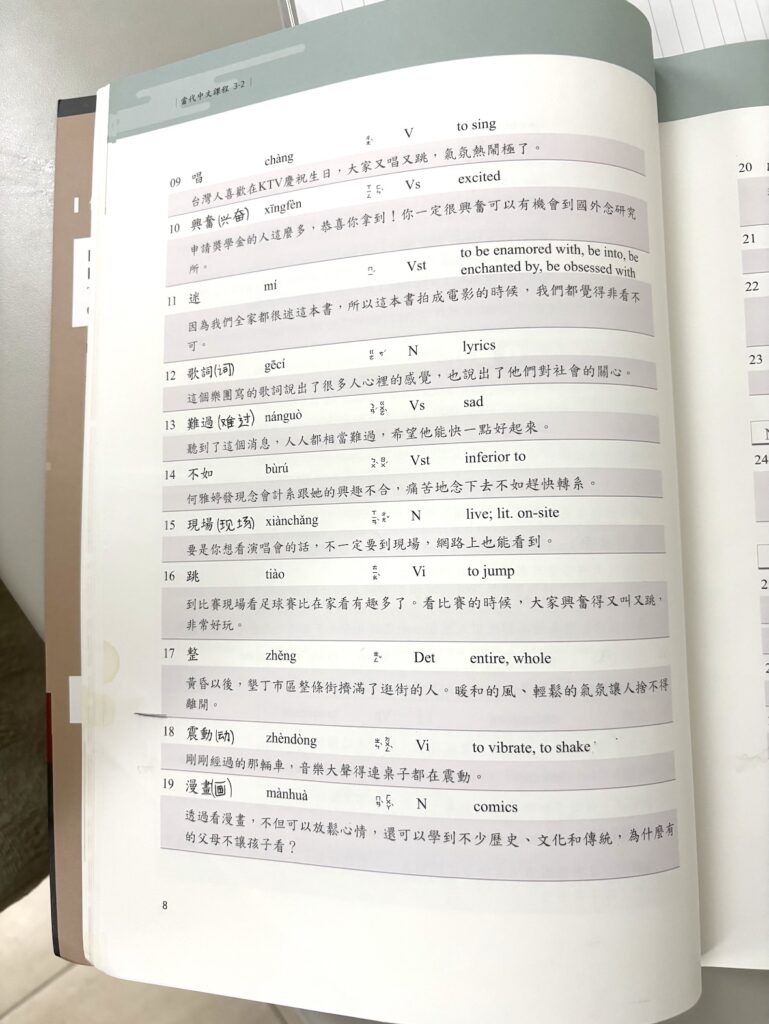
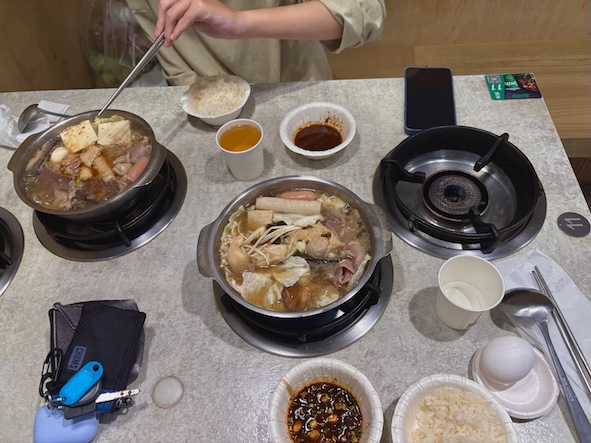
Less noteworthy instances off the top of my head – I learned how to say congee (粥zhōu) and then ordered it that week at a restaurant, learned words about discounts and shopping and then used Chinese to return some pens that I bought, learned hotpot-related words and use them super often, as hotpot is really popular in Taiwan.
My Life as a Classroom
I think having these organic opportunities to practice is probably the best part of the study abroad experience. A huge difficulty in language learning in the U.S., in my opinion, is that it’s really hard to practice the material you’re learning outside of the classroom environment. We learn languages not to just answer questions from the board, but to express ourselves out in the real world, with real people, in a way that feels authentic and genuine (I actually just learned the word for “genuine” yesterday! It’s 真正zhēnzhèng).
Learning a language without an immersion experience isn’t impossible, but studying abroad has made it so much easier. I definitely have good Chinese days, where speaking comes naturally, and not-so-good Chinese days, where I have to think extra hard to piece together a relatively simple sentence. But hearing or using what I’ve learned always gives me a little boost, and it’s those moments that really motivate me to keep practicing.