
By Steven Tu ’29
I didn’t expect to leave a documentary screening holding a piece of bamboo. I definitely didn’t expect it to mean anything.
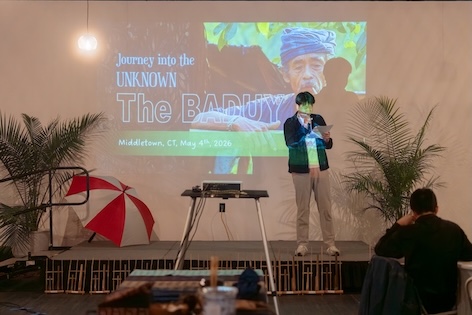
That’s what happened on the afternoon of May 9, at the first public event ever held at One Muni, Middletown’s new Community Center. Maxwell Wijaya, a high school junior at Choate Rosemary Hall, curated the afternoon around his documentary Sacred Isolation, which follows the Baduy, an Indigenous community in Indonesia that has held onto much of its traditional way of life by choosing, carefully and on its own terms, how much of the modern world to let in.
I walked in thinking I was there to watch something. I walked out having taken part in it.
The afternoon opened gently, with Professor Mark Brooke giving us just enough context, geography, history and culture to understand how much bigger and more layered Indonesia is than most of us probably assumed. Most people, myself included, tend to picture the same handful of images when they hear the word: beaches, temples, maybe a Komodo dragon. Brooke’s talk quietly dismantled that, laying out a country made of thousands of islands and hundreds of distinct ethnic groups, each with its own relationship to tradition and change.
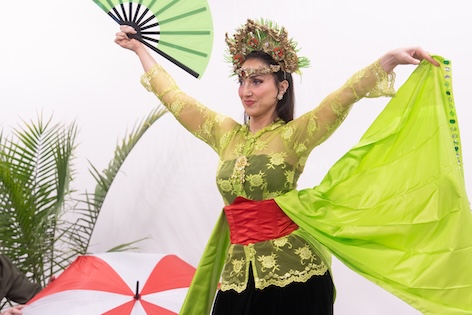
Then, a traditional Javanese dance performance filled the room with color and rhythm before the film even started. The dancers moved with a kind of restraint that felt intentional, nothing rushed, every gesture precise, and by the time they finished, the room had gone quiet in a way that felt like anticipation rather than politeness.
When Maxwell’s documentary began, it moved with that same patience, while telling the story of the world of the Baduy. It followed how the Baduy pass knowledge down by voice rather than by writing, and how deliberately they’ve protected that way of life, generation after generation, not out of fear of the outside world, but out of a clear-eyed choice about what they wanted to hold onto. Watching it, I found myself thinking less about the Baduy as a subject to be studied and more as a community that had simply made a different set of decisions than the ones the rest of us take for granted.
During the Q&A afterward, Maxwell said something simple that I haven’t stopped thinking about: “Most conversations about Indonesia stop at Bali or the Komodo dragons.” He wasn’t correcting anyone. He just wanted to open the door a little wider, to let people see a version of his country that rarely makes it into conversation, let alone film. By asking audience simple questions like “What do you think is the most prominent color in Baduy culture?”, he brought pieces of his culture, bit by bit, across the sea, into people’s perception of the Baduy community.
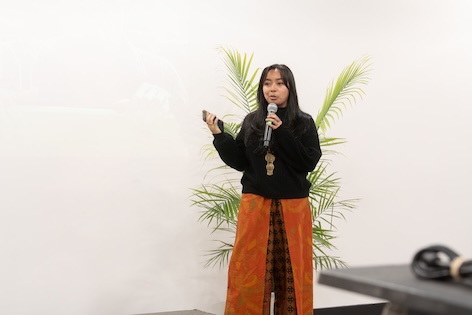
Then, Venska Pongoh spoke, and something in the room softened even more. She’s a Columbia University student of Indonesian heritage, born and raised in the U.S., and she talked honestly about what it feels like to hold onto a culture from far away, without the language close by, without the land underfoot. She mentioned wanting to build programs that could introduce Indonesian culture to younger generations who might grow up the way she did, connected to a place mostly through family stories and secondhand memory. It didn’t feel like a separate topic from the film. It felt like the other half of the same question, asking not just how to protect a culture from the outside, but how to keep loving one once you’ve already left it.
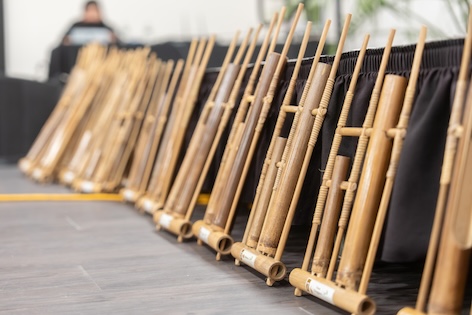
And then, almost like the room needed to stop talking and just feel something instead, the angklungs came out.
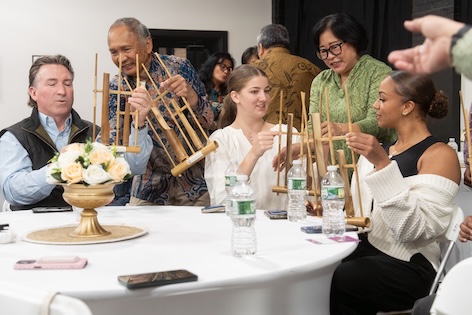
They’re small bamboo instruments, each one holding a single note. On its own, an angklung doesn’t really do much. You shake it, and out comes one thin, dangling sound. But everyone in the room got handed one, and after a few uncertain, giggly rounds of practice, something genuinely lovely happened: the notes found each other. What had been a room full of strangers making separate little sounds slowly became one song carried across the hall; all of us holding our one note and trusting everyone else to hold theirs. I remember looking around at one point and realizing that no one in the room could have played that song alone, and somehow that felt like the whole point.
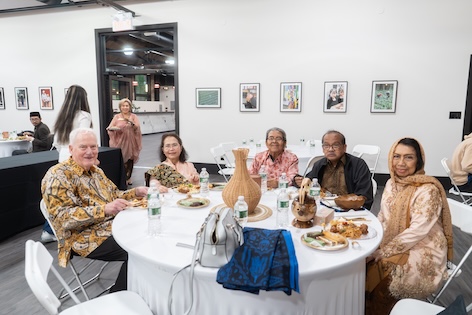
I was still thinking about that as we made our way to the food table, where the room loosened up even more over nasi goreng and satay ayam. We’d spent two hours talking passionately and thoughtfully about what it means to preserve a culture. But it wasn’t until I was standing there with an instrument that couldn’t do anything by itself that I actually felt what the afternoon had been trying to tell us all along.

I still have that piece of bamboo. It sits on my desk now, and every so often I pick it up and shake it, just to hear that one thin, incomplete note again, the same note it made that afternoon, before it became part of something bigger. I think about that afternoon a lot, actually, how none of us could have made that song alone, and how none of us tried to. Maxwell didn’t just ask us to think about how a culture survives. He handed us an instrument, put us next to strangers, and let us feel it instead. What I didn’t expect was that his screening would end up teaching the rest of us the same lesson the Baduy have spent generations learning: that some things only become whole when you’re willing to be one small, indispensable part of them.