

By Alexander Ober ’26
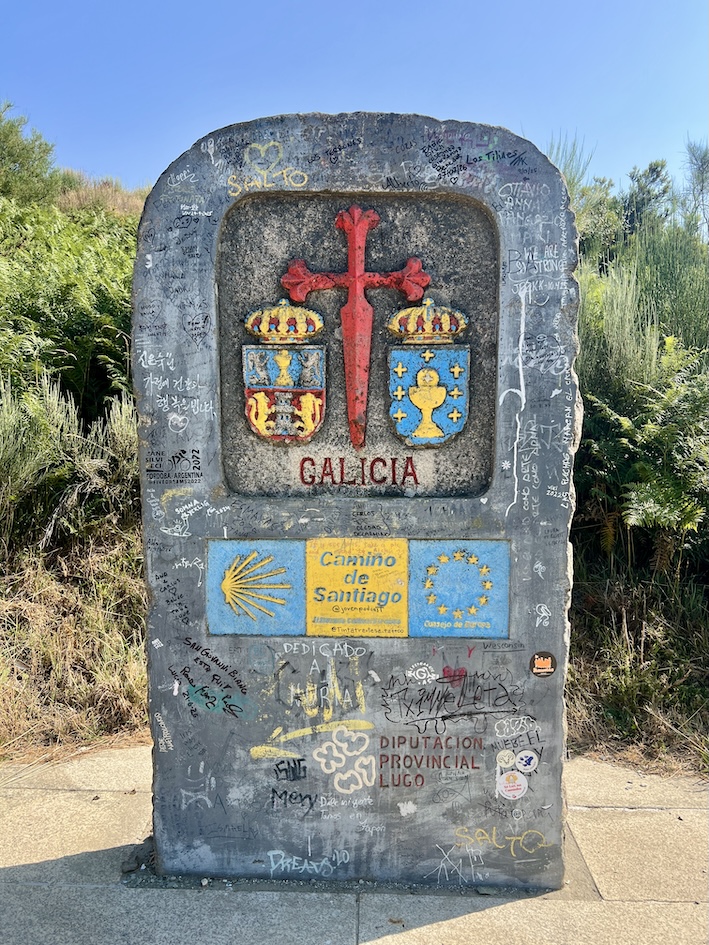
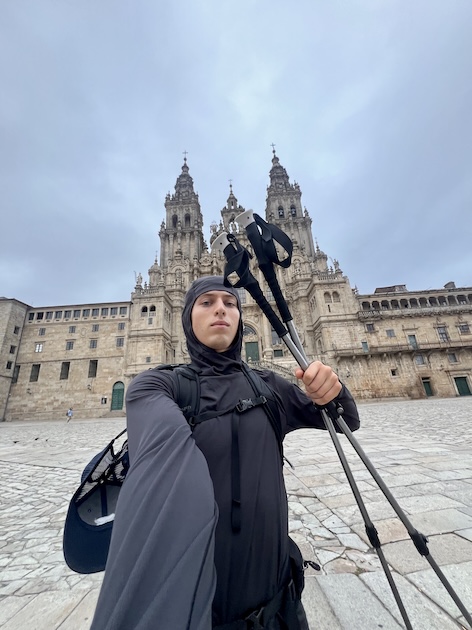
This summer I had the opportunity to walk 500 miles solo on El Camino Francés (the French Way), funded by the United States of Adventure (USOA). I documented my journey and observed the religious practices associated with one of the most famous pilgrimages in Christianity to the Santiago de Compostela Cathedral, the alleged site of the remains of Saint James.
The legend is that Saint James traveled to Galicia to spread the Gospel and felt a deep spiritual connection to the land. After returning to Jerusalem, where he was arrested and beheaded in 44 AD, his disciples, guided by angels, navigated a stone ship to bury his remains on the Iberian Peninsula. It was not until 814 AD that a Christian named Pelayo discovered the tomb after a “Campus Stellae” (field of stars) appeared over the forest, illuminating the Roman crypt of the Saint. Politically, this discovery served as a unifying symbol for the Christian Kingdoms emerging out of the conquered Visigothic state, which had lost nearly the entire Iberian Peninsula to the Muslim Umayyads. In the early 9th century, King Alfonso II completed the first recorded pilgrimage to venerate the Saint, and now over 500,000 people each year traverse the Peninsula on foot to see the Romanesque and Baroque cathedral, whose construction began in 1075 over the tomb.
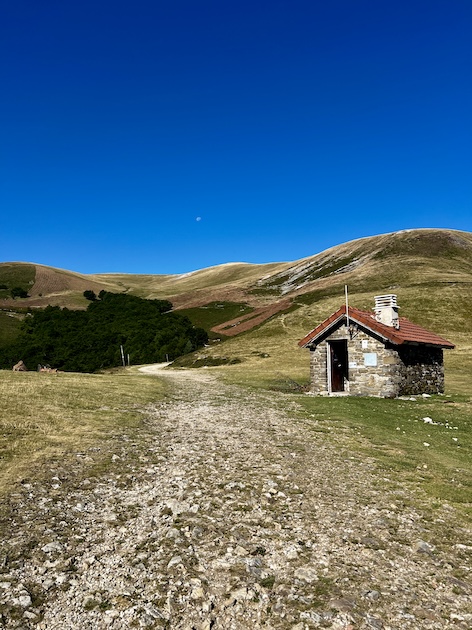
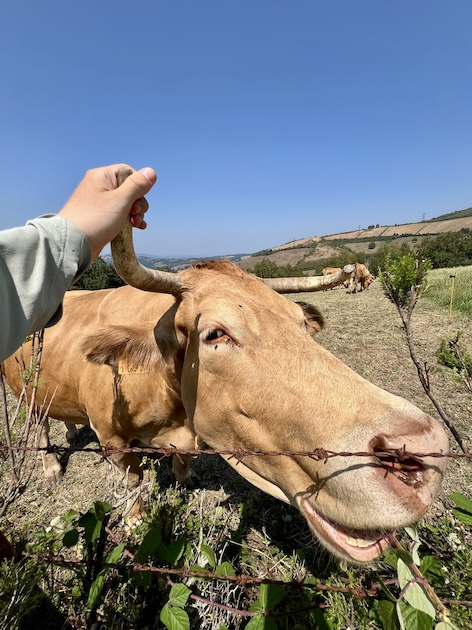
The first morning I backpacked from Saint-Jean-Pied-du-Port, France, crossing the Pyrenees into Roncesvalles, Spain, the route famously traveled by Napoleon Bonaparte and his armies to invade Spain in the early 1800s. Along with about 20 pounds of supplies, I carried a native scallop shell tied to my bag as an indication of my pilgrimage, which historically was used by pilgrims as a multitool and is a common image associated with the arrival of the Saint’s funerary boat. The mountainous terrain was expansive and breathtaking, and covered with religious shrines and livestock that seemed to manage the ascent to the peaks and knee-burning descent much better than the droves of people arriving at the monastery hostel, feet covered in blisters. There I met two new friends, Kim and Jiseok from South Korea, after randomly being assigned to a dinner table together, who would create some of my more memorable moments on the trail.
I walked for somewhat touristic reasons, wanting to explore the northern half of Spain, but to that end I did have incredible luck. Completely by chance, I arrived during the summer festivals of many of the more noteworthy cities, including at the first major stop, Pamplona, during San Fermín and the running of the bulls. The city was very lively, and I witnessed many interesting traditions, including a parade of giants, saints, and Kilikis and Zaldikos chasing children with foam mallets. The highlight was, of course, the running of the bulls, for which I had a great vantage point atop the fence at the famous curve in the course where mozos in their customary white outfits with red accents must avoid the left-hand side of the bulls so as not to be crushed should the bulls’ legs give out on the turn toward the plaza. It was a chaotic mess of falling, shoving, and pulling that was also somehow orchestrated, as people would pull others away from an ensuing bull horn, or stop them from passing the bulls on the left-hand side at the turn. Thankfully, nobody was seriously injured that day. The national news broadcaster RTVE interviewed me after the event about my pilgrimage, which led to overnight “fame,” as I was stopped multiple times along the trail, having been recognized from television. My good fortune also coincidentally brought me to Valladolid the evening of the World Cup final, where Spain took on Argentina. I befriended a group of Spaniards my age playing football in the main plaza who invited me to watch the match with them at the viewing party there. I was quickly branded with red and yellow paint and flags despite my quiet support for Messi in his last World Cup. The atmosphere was tense with the Spaniards feeling robbed by disallowed goals, until the final whistle blew, at which point the crowd erupted. Young children climbed the statues and terraces of the plaza to hang Spanish flags, and my new friends lifted me into the air as their proclaimed good luck charm from New York, where the final was played.
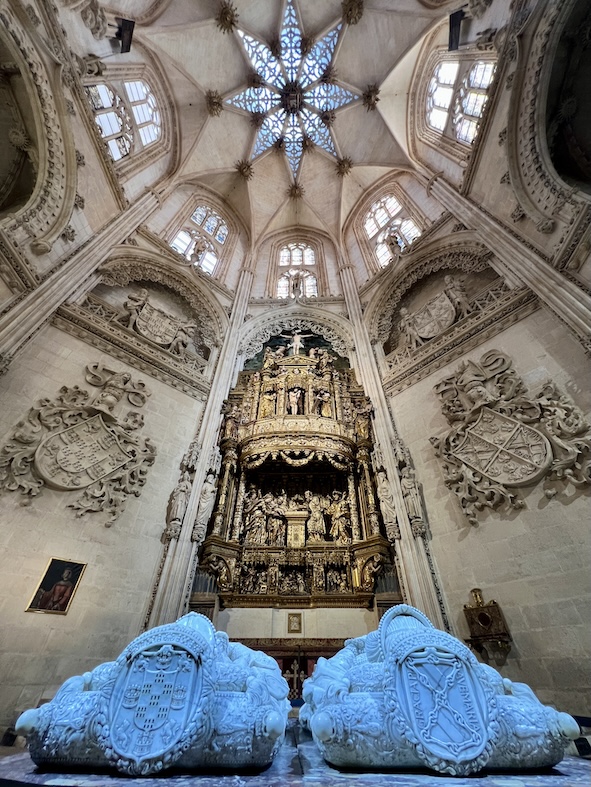
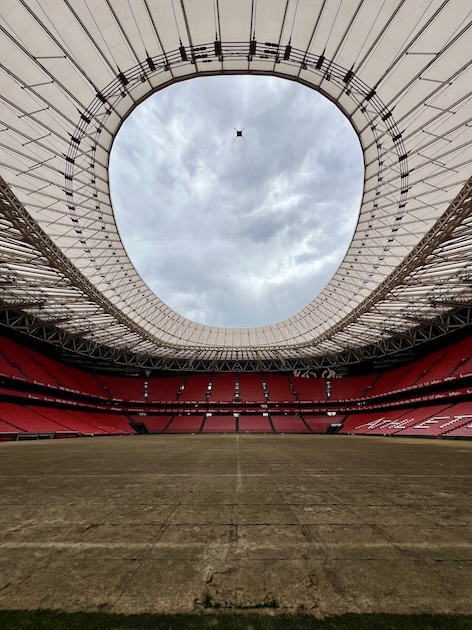
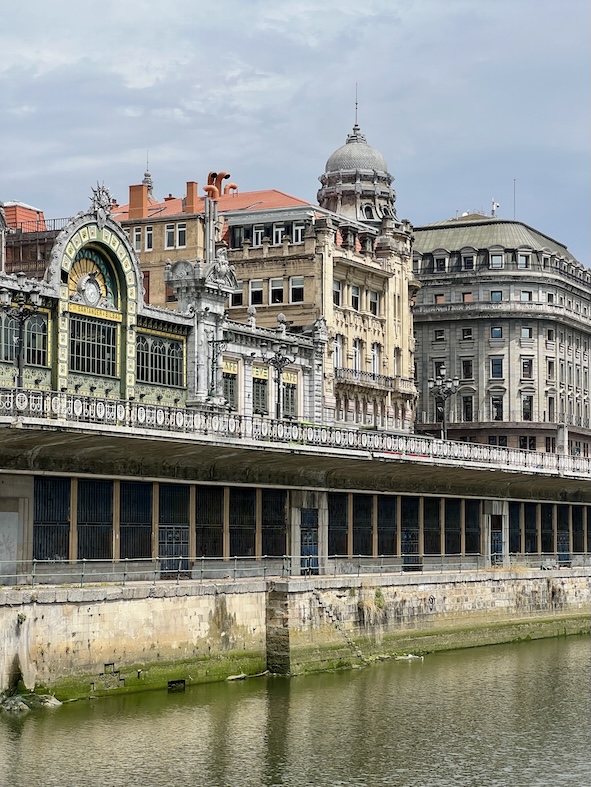
There were dozens of these magical moments on the trail. In Gijón, the skies directly above the city and its beaches suddenly became a playground for aircraft spinning and diving. In Astorga, Roman gladiators fought in the bull arena against the Astures. In O Pedrouzo, a man controlled the movements of a herd of horses, at times standing atop two at once while others danced or hurdled each other. In Bilbao, artists performed across the city in an isolated language, Euskera, a cultural phenomenon that survived in the Pyrenees over years of war. In Burgos, I encountered El Cid and Jimena Díaz, laid to rest in the Cathedral after crossing the same Roman roads and bridges as they did. On an excursion to Portugal, in Braga, I watched a football match played on the side of a cliff in the city’s search for continental sporting glory. In Porto, the miraculously ornate church of São Francisco covered in gold felt like the closest humanity has come to recreating a higher place like heaven.
What I appreciated most, however, was the way the world opened up to me through the interpersonal relationships on the trail. Kim and Jiseok were on the El Camino after completing mandatory military service, and joined the many others who have decided to walk in recent years from South Korea after trips on El Camino were aired on a few variety and reality television shows. After Pamplona, they ended up a few stops ahead of me, but we stayed in touch through messages. Jiseok accidentally stepped on and broke his shell outside of Estella and left it behind, continuing to Santiago de Compostela without it. It had an inscription on it that was a dream he was to hopefully fulfill by completing the journey. I suggested that he should still carry the broken pieces with him, but he told me he had a new dream. I had a different sense of determination for his dream, and after I left Estella at 3 am I searched the sides of the trail for the shell, hoping to return it when I caught up at some point. It was pitch black, and I was quickly losing hope as he had not told me its exact location. At the far outskirts of the city, I randomly turned around and spotted the shell hidden behind a post, which I excitedly bagged to take with me. In the next town, a South Korean couple I met translated the message he had been displaying on his backpack, which was “I hope to make easy money in life, for example, winning the lottery.” It was pretty comical, as I had expected some more profound religious sentiment, but I think financial freedom to explore the world how he does is a great wish. In Bilbao, I found a keychain with a Spanish lotto ticket and a toy soldier to gift my friends when returning the shell. I surprised them, and after that moment, we proclaimed we would be friends for life. They gifted me some delicious kimchi noodles in return, and I am certain I will see them again either in the United States or South Korea.
There were many interesting people and reasons for walking. Another couple I met was on their honeymoon, which did seem like an excellent test of “in good times and bad” right from the start of their marriage. Many walked to atone for something in their lives: infidelity, violence, drug use. I am sure the passing of such incredible holy sites along the trail brought some form of enlightenment, but the physical component of walking also seemed like a kind of self-flagellation for some. There were even 80-year-olds covering kilometers of distance every day, as they had done yearly almost their whole lives. The spiritual power of others’ religious practices was palpable, despite my different spiritual practices. Towns in the middle of nowhere would have the most miraculous churches I had ever seen, or in a random field, a holy site would appear that had survived a thousand years through times of war. Coming into contact with these religious practices showed me new ways of appreciating life or finding strength within myself even though I am not a Christian.
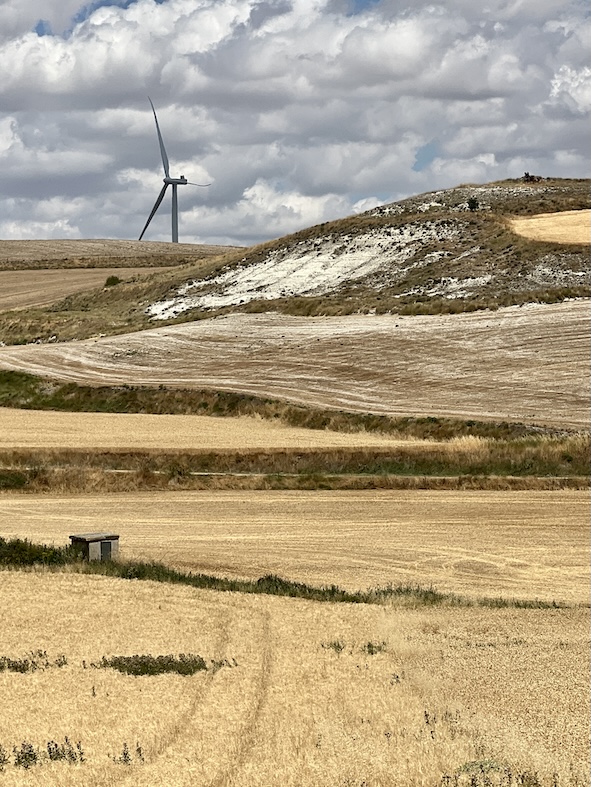
One of the more evident experiences with this came from meeting a man briefly in a cafe on La Meseta, the approximately 200-kilometer stretch of the Camino through flat, arid terrain. I told him my goal of walking 80 kilometers in a single day, through one of the harder sections, more grueling for the incredibly high temperatures, little cover from the sun, and monotonous backpacking. He took my hand and told me he was going to pray for me that night, and said it so earnestly and with such conviction that I really believed he would be looking out for me. That night at 11 pm, I ventured out, repeating the famous phrase “sin meseta no hay camino” (“without the Meseta, there is no camino”), and remembering that someone was sending positive thoughts my way for a successful outcome. Despite this reassurance, it became the most mentally and physically excruciating goal I have ever attempted. The first few hours of walking through fields were enjoyable under the moonlight. The next four hours, however, were in complete darkness without a personal light. I could only see a few feet in front of me and was constantly bumping into the brush or mistepping on a rock. At 20 kilometers, I got a blister so bad that I could not put any pressure on my foot. I stopped to treat it, but after wrapping it, it was still incredibly tender. Miraculously, the pain went away completely after a small adjustment, and so I carried on, practically pleading at a certain point for the sun to come up. I had a bit of a scare when I encountered wild boar piglets near the trail who started squealing; I assumed to alert their mother, which prompted me to sprint onwards to get away from them. At 50 kilometers, I stopped for a quick breakfast, and my legs completely locked up. I hobbled on until 65 kilometers, when something in my foot seemed like it burst open and the whole foot felt like it was on fire and at the same time almost numb. This sudden shock went away quickly somehow, and I kept going, with the sun now at its peak beating down on me for the last 15 kilometers. I arrived in Leon distraught, wishing for nothing more than for it to be over, but the sense of achievement outweighed the pain. For the rest of my life, in hard times, I will always think back to how I was able to push myself and endure those circumstances. I was thankful for my mantra and the kind wishes of those I had met on the trail for keeping me going.
After 29 days, I reached Santiago de Compostela and had one last stroke of luck on the trail, as I got to witness the Botafumeiro inside the cathedral, a large swinging censer that spreads incense throughout the building in a very dramatic fashion. I ran into some other friends I had met on the trail, and we all celebrated together, with talks of future pilgrimages to Mecca or Jerusalem. After the mass, I went to the pilgrim’s office to pick up my Compostela, a certificate given to those who complete the trail, and walked the streets of the historic city after retiring my hiking poles. It was overall a wonderful opportunity after graduating from Wesleyan to reflect on what I hope to do next in life. I arrived home feeling more assured of who I am, and in some ways freer. The trail has a way of breaking down your ego, whether through relying on others; collaborating with strangers; or simply feeling vulnerable out in nature carrying very little, which in its own way is all liberating. I made connections with people across the globe that will hopefully lead to great new adventures someday.