


By Charlotte Li ‘28
In 2022, I was scrolling through my feed, heart heavy with news reports, when I came across a post advocating for collective action against the muting of women’s voices on social media. The post included pictures of white characters against a red background that I didn’t recognize. I did not know anything about it yet, except that it was a secret women’s language, but I felt something shift within me.
That was Nüshu. Centuries before modern feminism, women in Jiangyong County, Hunan Province had found a unique way to express their sorrow and anger in the rigid Confucian society. They lived within its structures — raising children, managing households, embodying the roles of dutiful daughters and virtuous wives. Formal literacy was a male privilege. And yet, they created Nüshu as a secret language of communication between women, with soft and delicate brushstrokes that looked, underneath, like sharp knives.
What struck me most was not just the history but the strategy. These women did not waste their energy trying to change the immovable Confucian system that limited them. Instead, they created a system that is entirely new, one that exists parallel to, yet separate from, the dominant culture. They did not try to convince the men at their dinner tables to understand their perspective. They built their own tables where their voices could be heard and understood.
This was not just a language. It was an echo of resistance that belonged to my own cultural lineage. Growing up between China and Hong Kong, suspended between languages and identities, I had long been searching for Chinese feminist roots I couldn’t trace. Western feminist theory had offered me valuable frameworks, but it cannot account for the specific cultural nuances of Chinese society. Without understanding Chinese feminist history, I felt I was borrowing someone else’s language to describe my own experience.
Last year, I reconnected with Rosie. Rosie, a now PhD student in art at Hongik University in Korea, and I first met during a research trip to Jiangyong in 2023. She has been incorporating Nüshu into her artwork since her master’s studies in the UK, using it as both medium and message. On her wall in Seoul hangs the Nüshu character for “freedom,” written for both of us by a heritage bearer that summer. That single character, hanging thousands of miles from where it was written, symbolized our parallel journeys with this script.
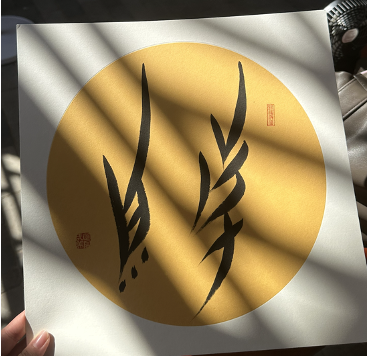
In our conversation, Rosie said: “Nüshu can increase our visibility because of its uniqueness.” And I told her: “In the fragmentation I’ve felt during this identity migration, Nüshu gave me a thread of belonging. It comes from a culture I know, a society I came from.”
A language carries what people cannot say out loud. Nüshu carried centuries of it in secret, in beauty, passed between women’s hands. That power has never left.